Anglican Church of Kenya
From housewife to entrepreneur:
Jacinta’s story
After Jacinta Mutua’s husband died, she struggled with only an irregular income. To see her three grandchildren through school, she was forced to sell all the animals she had inherited from her late husband.
But when ABM AID’s partner in Kenya, Anglican Development Services Eastern (ADSE) came to Mbuvo, 52-year-old Jacinta saw an opportunity. In 2024, she joined the Wendo wa Ndiwa Women group, a widows/widower’s group which was formed by the project. This is her story.
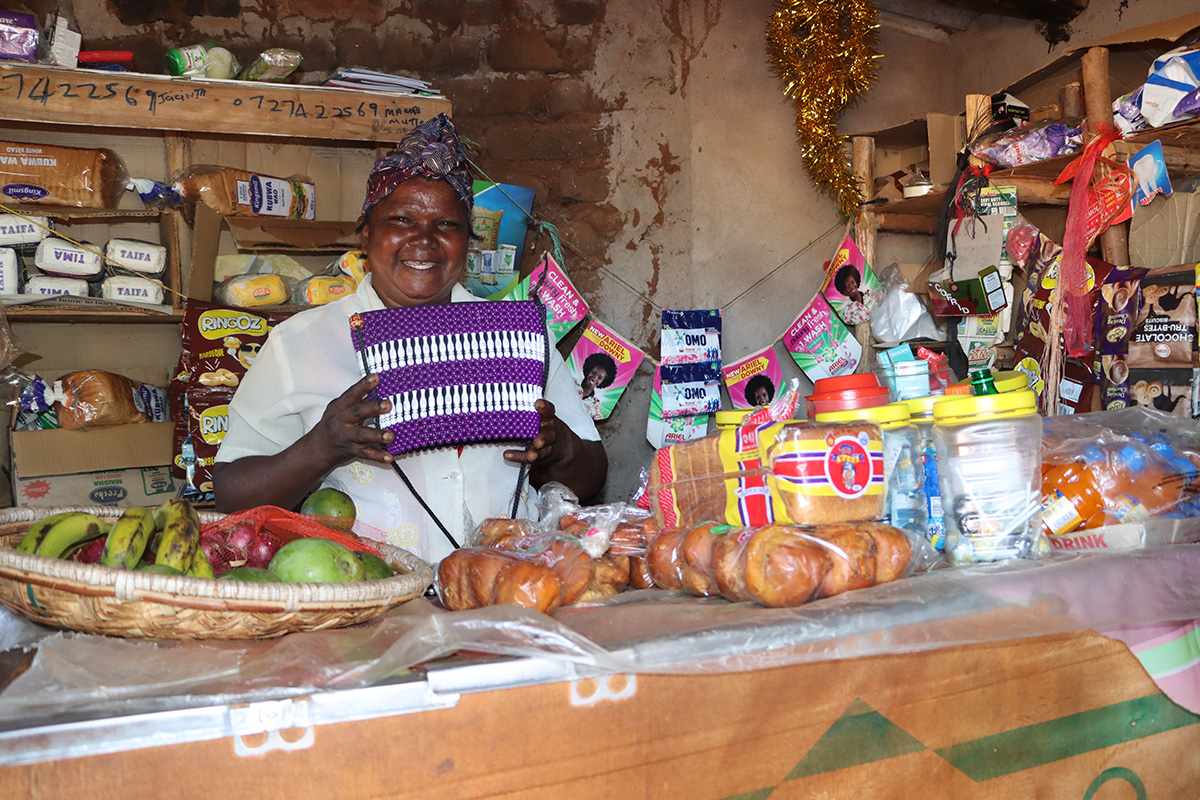
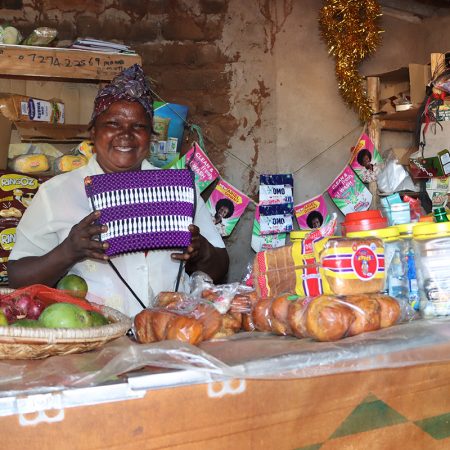
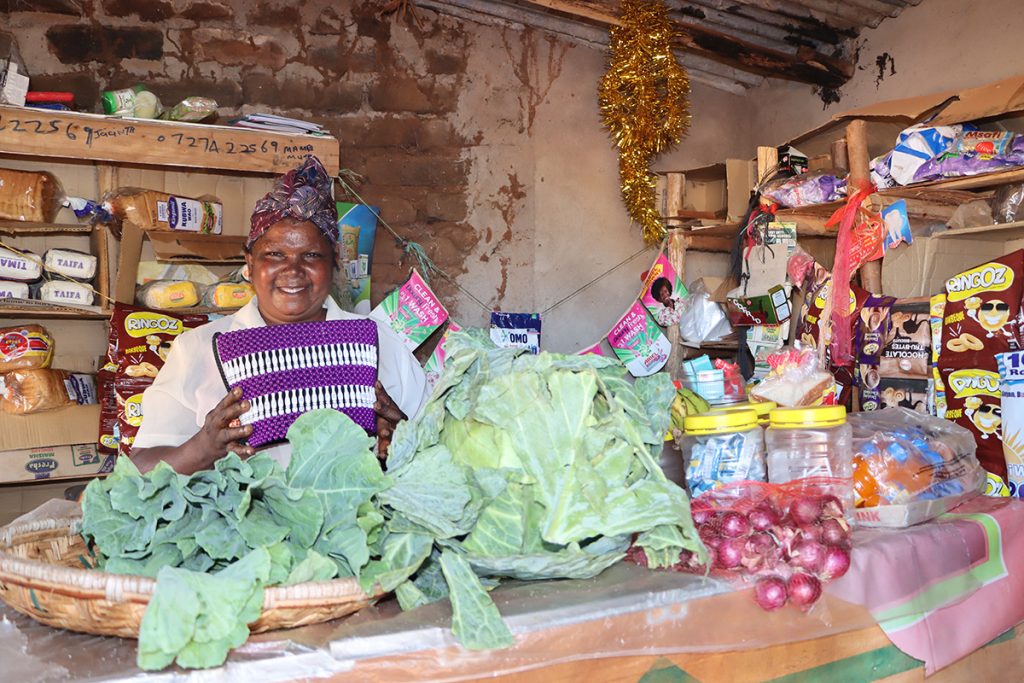
Jacinta Mutua at her shop showcasing the baskets. © ADSE. Used with permission.
“Through the knowledge I gained from this project, I was able to take a loan of KES. 5,000 and secured a shop in the nearby local market and started a small retail business. I started with few items like 5 litres of cooking oil, 10 kilograms of rice and 5 packets of wheat flour and other small household items which the community require daily. The reason for starting the shop was to ensure that I had a consistent source of income.
“A group share out was done in December 2024. I got KES. 9740 from my savings which I used to boost the business. I purchased a hen, and bought 20 litres of cooking oil, a bag of 25 kilograms of rice and a bag of 10 kilograms of sugar among other items. Purchasing the goods in bulk and selling in retail has more profits as compared to buying in smaller quantities.
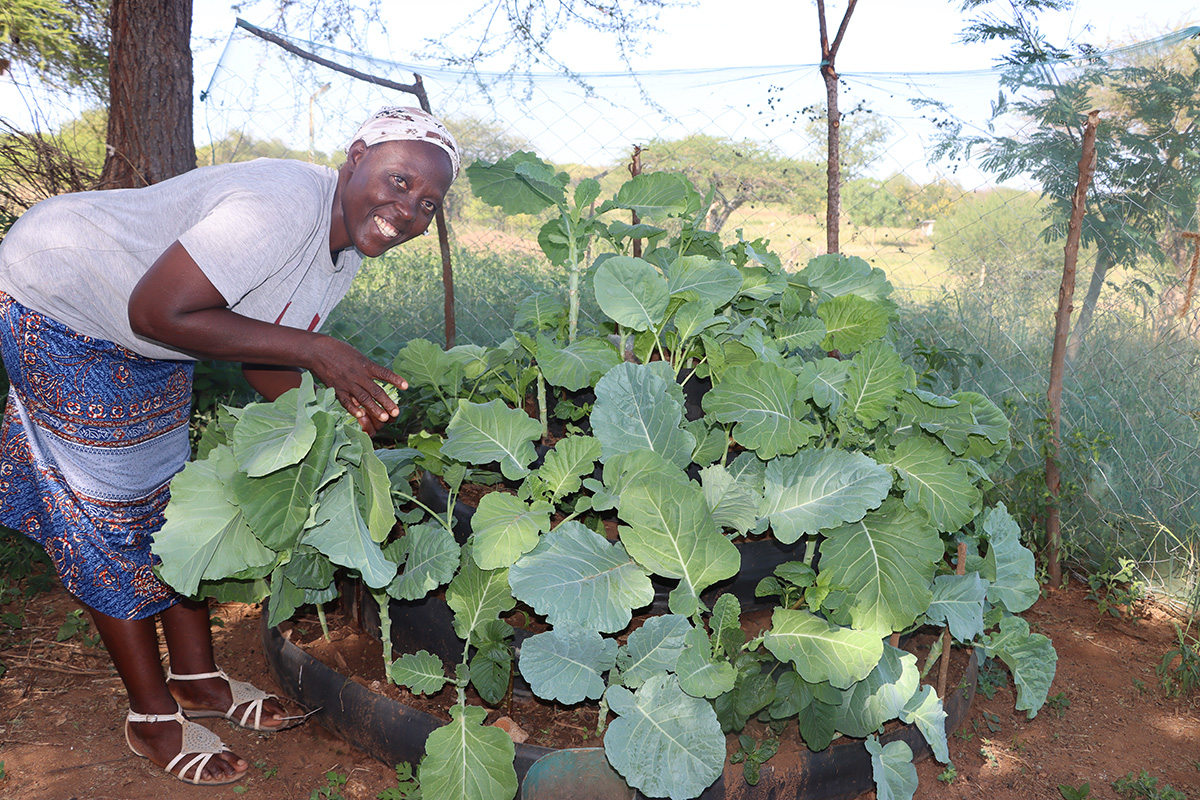
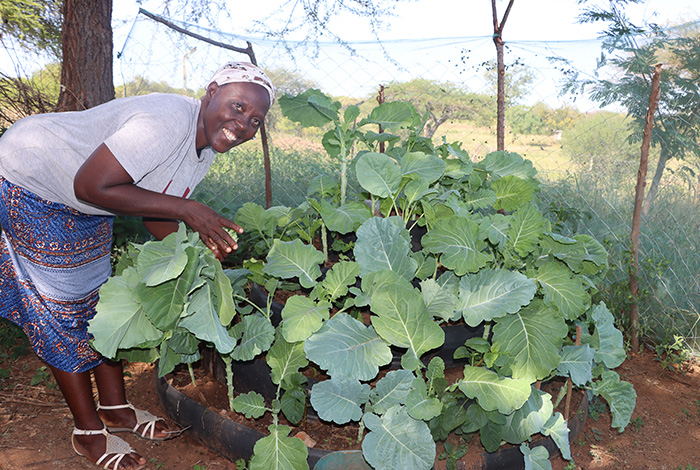
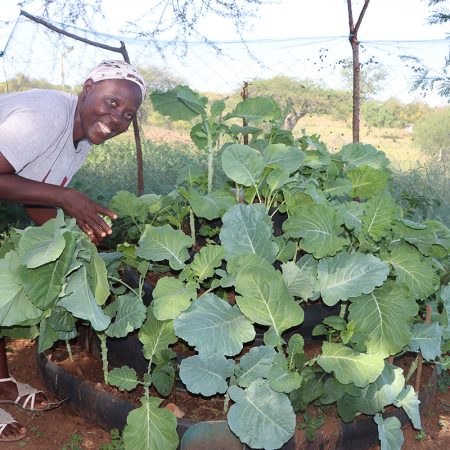
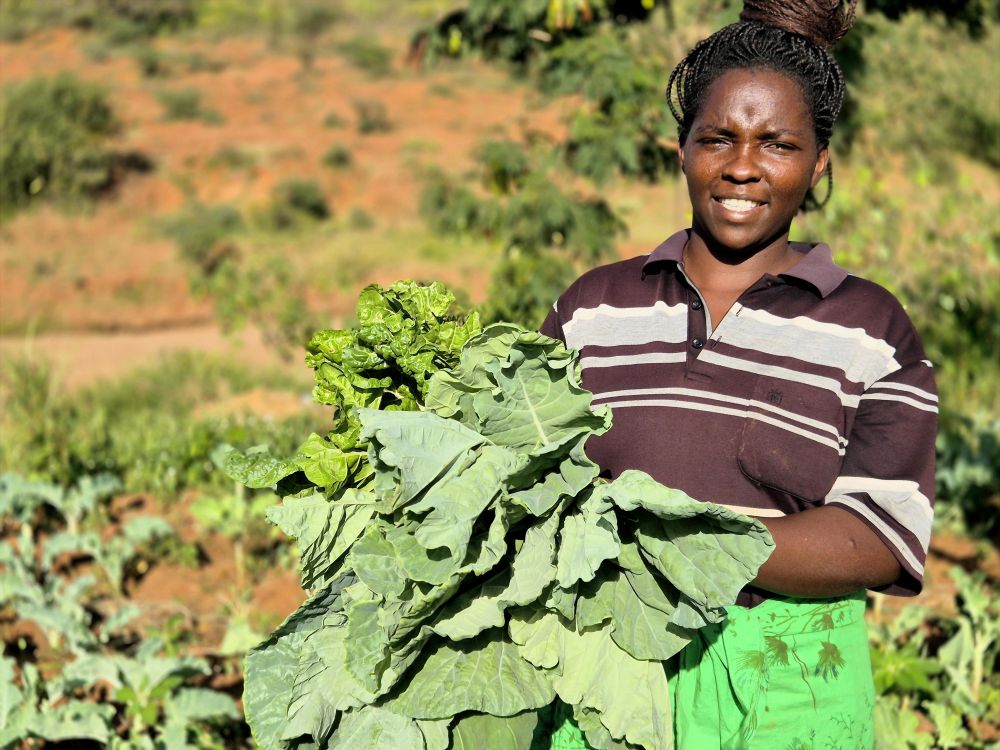
Catherine harvests her kale to sell through Jacinta’s shop, providing a more stable income for her family. © ADSE, used with permission.
In addition, I get vegetables worth 150 shillings daily from group members who have established conical gardens which I pay back later in the day after selling the vegetables and I retain the profit. This has helped to give me a steady source of daily income for my household.”
Our Partner – the Anglican Church of Kenya
The Anglican Church of Kenya currently has 41 dioceses and ABM AID works with three of those: the Dioceses of Machakos and Makueni through ABM AID partner Anglican Development Services Eastern (ADSE), and the Diocese of Eldoret.
Anglican Development Services Eastern (ADSE) has been implementing community development projects in the arid and semi-arid lands of Eastern Kenya for many years. Their work aims to improve the livelihoods of the most vulnerable communities, making them more resilient to the effects of climate change. These communities are chosen according to their rating on the Multidimensional Poverty Index, developed by the United Nations for assessing families and individuals in greatest need.
Working with the Diocese of Eldoret, AID supports two small initiatives conjunction with the Diocese of Perth, Australia, which has a Partnership in Mission with Eldoret:
- Community-Based Rehabilitation (CBR) Centre’s Economic Empowerment Program for People Living with Disabilities. The Economic Empowerment work seeks to improve independent livelihood opportunities for people living with a disability by offering training, mentoring, and small revolving low-interest business loans. It also raises awareness of the rights of people with disabilities among local churches and the community more broadly.
- Enhancing children’s access to school education. This work started in 2025. It focuses on providing a nutritious school lunch for students living in poverty, together with some scholarship support.
The Work We Support
1. Empowering Farmers to Thrive in a Changing Climate
Farmers in semi‑arid regions stand on the frontlines of climate change, battling long droughts and the constant threat of food shortages. ADSE partners with these resilient growers, empowering them with climate‑smart farming methods, innovative water‑harvesting solutions, and hardy, drought‑tolerant crops that help secure their livelihoods, even in the toughest conditions.
ADSE train the group members on Village Saving and Loans (VSL). Farmers, like Jacinta and Catherine, gain skills in basic financial planning, saving discipline and responsible borrowing. This helps them to be able to put their little earnings into weekly savings. When the group forms a VSL kitty, members contribute their savings and actively participate in group planning related to savings and loan use. Other ADSE trainings members attend are on group governance, establishing commercial seed plots using conservation agriculture, establishing conical gardens (which are water efficient to grow vegetables) and training on basket-making as alternative income generating activities. For farmers like Jacinta and Catherine, these trainings are an eye opener.
Jacinta said that participating in the VSLA had given her confidence and a sense of control over her finances, noting that saving together motivated her to remain disciplined and focused on long-term benefits.
Jacinta’s story is just one example of how your support through ADSE has helped to transform the lives of many farmers and their families. With your support and ADSE’s expertise, more farmers like Jacinta can gain the tools they need to secure their livelihoods and protect their families from the worsening impacts of climate change.
2. Disability Inclusion project and Education Opportunities project in Eldoret Diocese
- (a) Championing Inclusion for People Living with Disabilities
People with disabilities are gaining confidence, independence, and economic opportunity through the Diocese of Eldoret’s Community‑Based Rehabilitation (CBR) project. Margaret, a determined market vendor living with cerebral palsy, runs a thriving small business in Eldoret selling baby clothes and household essentials. Margaret proves that with the right support, every person can shine.
“This program has given me the confidence and tools to succeed.” Read Margaret’s and Dickson’s stories
With advocacy by the Community Based Rehabilitation (CBR) project, Margaret and other sellers have moved to a better location closer to town, which has removed the rental costs for their stalls. Margaret also received training through CBR that has helped her manage her business more effectively. She now supports her family and repays loans daily using MPESA, the mobile phone-based money transfer, payments, and micro-financing service. “This program has given me the confidence and tools to succeed,” Margaret says.
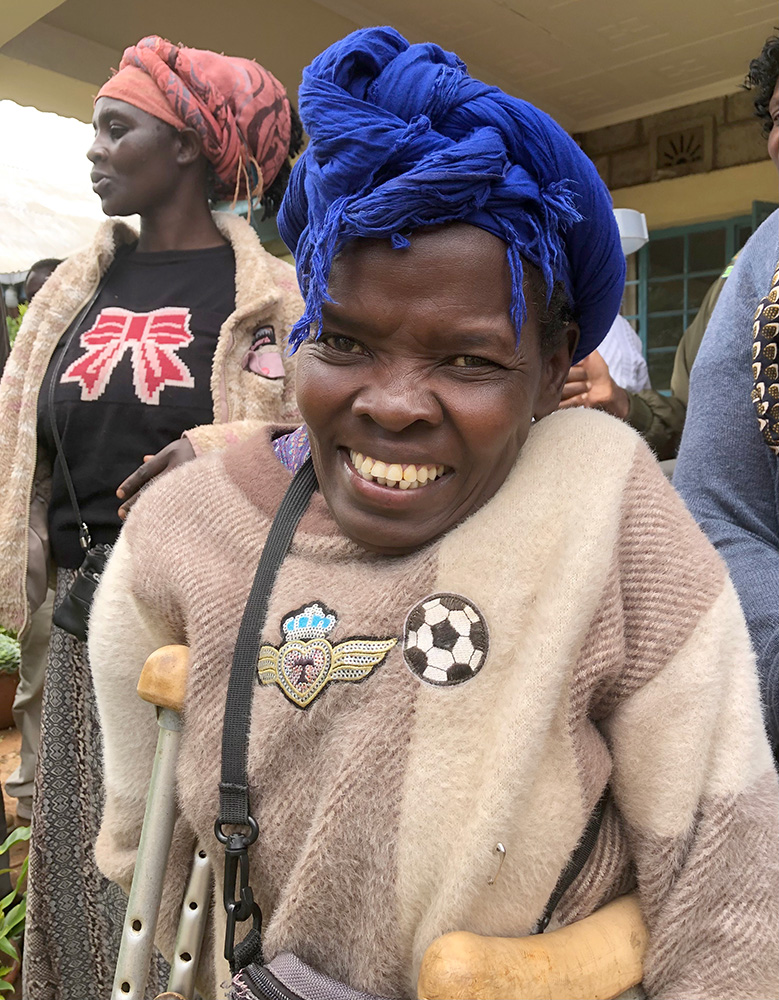
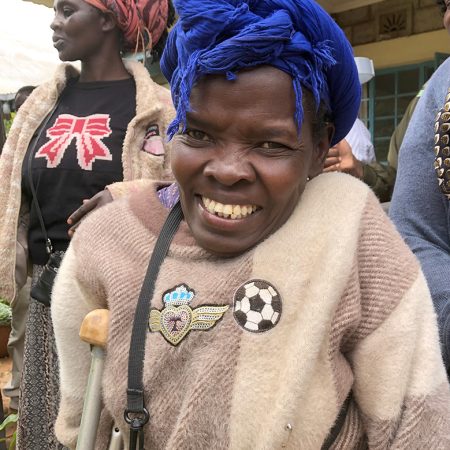
Margaret, participant in Diocese of Eldoret’s program. © Julianne Stewart/ABM
Another participant, Dickson, shares how CBR has strengthened his ability, and the ability of others with disabilities, to improve their livelihoods. “Disabled people often don’t have capital, but with support, we can do so much more,” he explains. Through his small business, Dickson has been able to feed his family and educate his children. “Educating our children is vital because they’ll take care of us in the future,” he says
With your help, and Eldoret Diocese’s commitment, people with disabilities can access the skills, support, and resources they need to live with independence, confidence, and dignity.
- (b) Expanding Educational Opportunities for Vulnerable Children
The Diocese of Eldoret is working to overcome the barriers that keep disadvantaged children from accessing education. A new initiative provides daily lunches at school and offers small scholarships that help cover fees and uniforms for the most vulnerable students, including children with disabilities. This support ensures that children not only remain in school but can thrive. Since education is a foundation for breaking the cycle of poverty, your support can help transform the futures of these children.
More information about Kenya
The East African nation of Kenya, home to 54 million people, has some of the best-known landscapes and peoples from that vast continent.
Although ancient in cultures and traditions, the people of Kenya have seen unprecedented change in recent decades. Prior to COVID-19, a series of significant structural and economic reforms contributed to sustained economic growth over that time, leading to a rise in income and growth of the middle-class. In recent years, however, debt servicing, high taxation and inflation levels, and the continuing impacts of climate change, have reversed some positive trends.
2024 saw increasing political social unrest, with students and others taking to the streets to protest a financial bill that many saw as unfair.
“Kenya’s Vision 2030 − which aims to transform Kenya into a competitive and prosperous country with a high quality of life − the government’s bottom-up economic model prioritizes agriculture, healthcare, affordable housing, micro and small enterprises, and the digital and creative economy”, (World Bank, October 2024).
However, for many the fight for survival is a daily reality.
Around 40% of Kenyans live below the income poverty line, and 19% live in severe multidimensional poverty. More than one quarter of children under 5 suffer from moderate or severe stunting due to poor nutrition. Kenya ranks 143rd of 189 countries for gender equality (measured in relation to reproductive health, empowerment and the labour market).
Women often bear the burden of both homemaker and bread-winner, and for those with disabilities, discrimination can bring precious few options for a meaningful future.
A Prayer for our Partner
God of life and hope, we give thanks for farmers in Kenya, whose courage and learning turn dry ground into abundance. Strengthen all who face drought and hunger. Bless their work with wisdom, resilience, and drought-breaking rain, that families and communities may flourish. We ask this in Jesus’ name. Amen.
God of dignity and compassion, we thank you for lives renewed through opportunity and support. Bless all who gain confidence, livelihood, and voice. Strengthen communities that remove barriers for vulnerable students, nurture learning, and open pathways to independence, justice, and hope. Hear our prayer for the sake of your Holy Name.
Amen.



Your support will help sustain this life‑changing work and uplift even more farmers and people with disabilities. Together, with the Anglican Church of Kenya, you can create brighter futures where those you support can grow, succeed, and truly thrive.
We hope to raise
$87,000
for this partner
Donation code: XG011
Tax-deductible
Donate Online Now
You can support the Anglican Church of Kenya to transform lives and build brighter futures.
Click here for other donation options
Need help? Call us 1300 302 663
As noted, this is a tax-deductible project. All donations are in Australian dollars (AUD) and all gifts of $2 or more are tax-deductible. Gifts are received by the trustee for the ‘Anglicans in Development Ltd’ ABN 86 647 293 481 Gifts will be applied to the support of projects selected. In the unlikely event of projects being oversubscribed or not proceeding to completion, donations will be applied to similar projects.
Updates
Water, Work, and Hope in Kenya: Annah’s Story of Resilience
Kenyan farmer Annah boosts harvests and income through village savings and loans, training, and a new sand dam, transforming her family’s livelihood and resilience in drought‑prone Machakos.
From housewife to entrepreneur: Jacinta seizes an opportunity
ADSE’s program in Kenya gives Jacinta the skills, confidence and financial resources to open a small business. Finally, she has a regular income.
Sarah benefits from cowpeas and loans
Sarah Ndinda Muasa was brought on a journey by ABM AID’s partner ADSE in Kenya. This is her testimony: “Katangi [in southern Kenya] is rocky and most of the times we harvest little to nothing from our farms. The majority of the people were not in groups before…


