From the Archives
Discover ABM’s early mission to the Chinese in Australia
Language warning: In the following article words and phrases are used that are no longer considered appropriate. Reader discretion is advised.
A Report from ABM Missionary Notes, 18 April 1898
Opening of the Chinese Church (St Luke’s) Wexford Street
On Thursday, 31st March, this very interesting and important event took place, and it gives us the opportunity of placing before our readers a few of the facts connected with the mission to the Chinese in Sydney, which is under the control of [the] Diocesan Corresponding Committee ABM.
In the month of July, 1879, there was (with the exception of Mr. George Soo Hoo Ten) not one single Chinaman in Sydney who had embraced the Christian Faith. Mr. Soo Hoo Ten was born in Canton, and, as he himself expresses it, was a heathen during the earlier part of his life. At the age of seventeen he was induced to go to San Francisco, where he entered A mercantile house. He remained for four years, and towards the end of his stay in the great western city of America was, under the mercy of God, induced to abandon his early teaching and embrace the religion of Jesus Christ. At the end of four years he left San Francisco for Sydney and on his arrival commenced business in Pitt Street. At this time the Rev. Canon Moreton became interested in him, and together with other Clergymen, who felt that something should be done for the Chinese in Sydney, carefully instructed him in Christian Truth, and at last introduced him to the late Bishop Barker, by whom he was appointed Catechist to his fellow-countrymen in Sydney. The first service was held in St. Andrew’s School- room on a Sunday evening in July, 1879, and from that time services have been conducted on each Sunday and Wednesday night. From the commencement of this invaluable Mission, week-night classes for Religious Instruction and English have been held, at first under the management of a paid teacher, and subsequently by voluntary teachers under the direction of Mr. Soo Hoo Ten.
The mission, which at first confined its efforts to the city, found it necessary to extend its work, and services were commenced in St. Silas’ School-room, Waterloo. In 1883, services among the Chinese of Lower George Street were commenced, and have since been continued in St. Philips’ School-room. In the same year a Church, built specifically for the Chinese, was opened by the late Primate at Botany, Mr. Soo Hoo Ten having previously been ordained to the Diaconate. The work had had so grown that it became necessary to appoint an assistant to help in conducting the many services which were held. The choice fell upon Mr John Yung Tchoy, one of the converts (through the instrumentality of the Rev Soo Hoo Ten), who was placed in charge of the Mission in Lower George St. Recently he spent some months in Missionary work among his countrymen on Tasmania, and has now returned to Sydney, where he is doing useful service.
Divine Service is held every Sunday at the Botany Church, and Holy Communion is administered once every three months. A Chinese Catechist is carrying on the services in the Botany Church and the night school for the Chinese, at the latter of which he is assisted by a number of English Christians. The services at St. Andrew’s school on Sunday nights were attended by over a hundred and fifty Chinese, a considerable number of these being Christians.
At Parramatta a school has been carried on for a considerable time by a number of earnest Christian ladies with great success. On September 24th, Archdeacon Günther admitted four Parramatta Chinese to holy baptism.
Much might be said of the Chinese converts who have been trained and sent to other Dioceses as Missionaries, or those who, having been brought by the grace of God, to Christ’s religion, have gone back to their native land to preach the Gospel to their fellow-countrymen, but enough has been said to show how wide and far-reaching has been the work of the Rev. Soo Hoo Ten and his colleagues.
Land was purchased in Wexford Street for the erection of a Church at a cost of £1000. The site is situated in the centre of the area populated by the Chinese. On October 8th,1896, the foundation stone was laid by the Most Reverend the Primate, but it was only during the past few months that the Committee felt justified in accepting tenders for the work. Once started, the work went on quickly, and the following description of the building from an architectural point of view will be interesting to our readers: —
It was built under the immediate supervision of the architect, Mr F. Morehouse, A.R.I.B.A., of 129 Pitt Street, being designed in the Gothic style the thirteenth century, with a feeling of Chinese detail in one or two particulars, so as to point to the character of the auspices under which it has been carried out.
Although a small structure, it yet contains all the features common to ecclesiastical work: for instance, there is a nave, with seating accommodation for about 250 worshippers; a chancel, with choir seating for about 16, with a Clergy vestry on the north side, and an organ chamber on the south side. The Communion table is raised four steps above the level of nave floor. The chancel is divided from vestries by carved cedar screens, in keeping with the choir stalls and reading desk, which are also of cedar. The pulpit is placed on the north side, and though simple in character is in harmony with the rest of the work. The open seating of nave is of kauri, stained and varnished. The flooring of passages of nave is executed in herring-bone pattern of mahogany blocks 18in. x 3in., and the chancel and porch have tiled floors. The roof is open timber work, stained and varnished. The ventilation is by inlets at the window-sill level and extractors on the roof (Bayle’s patent). The whole of the glazing has been excellently carried out in lead lights of Cathedral glass, by Messrs. Ashwin & Co., of Sydney, and reflects great credit on this firm. The artificial lighting is by means of pendants and standards, fitted with incandescent burners. A novel feature in the Church is a revolving shutter (made by S. Brady & Co.), fitted at back of chancel arch, thereby shutting off completely the chancel portion, so that the nave can be used for lectures, entertainments, &c.
The front elevation is of stone and open rilu brickwork (tuck pointed). The pigment to porch contains a panel stone, on which is inscribed A suitable text. The bell tower it forms a special feature, and is covered with copper and muntz metal, surmonnted [sic.] by a mot iron finial.
The whole of the work has been carried out in a most satisfactory manner by Messrs. Brown and Tapson, Builders, of North Sydney, and reflects the greatest credit on all concerned.
As we have already said, the building was opened for Divine Service on Thursday afternoon by the Archbishop of Sydney. His Grace was accompanied by his domestic Chaplain, the Rev. R. Griffith, and his chaplains – Archdeacon Langley and Canon Pain. The following Clergy were also present: The Rev. Canon Moreton; the Precentor of the Cathedral; the Principal of Moore College; the Revs. G. Trower, J. Vaughan, W. Hough, F. B. Boyce, Dr Manning, J. G. Southby, J. Hargrave, J. Dixon, M. Archdall, H. W. Mort, J. H. Mullens, H. W. Taylor, J. W. Gillett, A. Killworth, R. Noak, R. E. Goddard, R. R. King, G. D’Arcy Irvine, G. E. C. Styles, W. I. Carr-Smith, J. Best, W. A. Charlton, H. T. Holliday, J. G. Fenton, J. P. Olllis, A. D. Soares, R. R. Livingston, Dixon Hidson, W. H. Edwards, P. Presswell, C. A. Vaughan, and George Soo Hoo Ten. Among the laity we observed Mr. ex-Judge Wilkinson, Messrs. J. M. Sandy, Dr Houison (Secretary of the Mission), C. Gifford Moore, H. B. Cotton (Treasurer of the Diocesan Corresponding Committee), W. Russell, Esq., Quong Tart, W. G. R. Lee (On Tik Lee), C. W. C. Hatton (representing trustees St James’, Glebe), John Kent, J. S. Harrison, W. A. Varley, Ching Lee (C. M. A. Missionary from Bathurst), F. E. M. Naughton, C. I. K. Uhr, F. Pitney Martin, Rev. E. Masterman (W. C. T. A.), George Perry and Mr. Moorhouse, the architect.
The Archbishop delivered an address from the words, “I was glad when they said unto me we will go into the house of the Lord.” The evening preacher was the Rev. R. Raymond King (secretary of the Diocesan Corresponding Committee of the Board of Missions), who selected as his text Rom. i, part of verse 16 [‘ I am not ashamed of the gospel of Christ: for it is the power of God unto salvation to every one that believeth’]. On Sunday morning last the Archbishop was again present and administered the Holy Communion, at which there were 46 communicants. Archdeacon Langley was announced to preach at the evening service, but was unable to do so through illness, and his place was supplied by the Rev. John Dixon, who also conducted on Monday evening a service of Praise and Thanksgiving. It is most gratifying to observe what a large number of Chinese have attended the services; on Sunday evening there were upwards of 200 present.
It will, perhaps, hardly be credited that there are 14,156 Chinese in New South Wales, of whom no less than 10,428 are in the Eastern Division, and the great majority of these are in the Diocese of Sydney – yet these are the numbers returned in the last census. Is our one Chinese Clergyman to stand alone in the arduous undertaking of preaching the gospel to these heathen in our midst? The Archbishop in the recent circular called attention to this fact, and further stated that “the opportunity given to us for making Christian disciples among the Chinese who are at our very doors, and thereby qualifying them to bring the power of Christian truth to bear upon their fellow countrymen, both here and in China itself, there’s an opportunity which should be used to the utmost.”
***
Later that year, the 22 June issue of ABM Missionary Notes told readers that, ‘… in the previous annual report reference was made to the proposed transfer of the Chinese Mission to the Church Missionary Association. This was deferred owing to the absence of most of the bishops (who were in England attending the Lambeth Conference), but negotiations are nearly terminated, and It is expected that the transfer will shortly be duly made.’
Some Notes
George Soo Hoo Ten was by 1876 a tea merchant in Sydney. Three years later he was a catechist among the market gardeners of Botany and Waterloo, sponsored by ABM. Despite opposition from many Chinese, especially gamblers and opium dealers, and the bitter anti-Chinese sentiments among some Europeans, he began Sunday afternoon services at Botany and the St Andrew’s Cathedral schoolroom, as well as week-night classes in English. His first six converts were baptized in June 1882. He was made a deacon in 1885. Ten conducted missions in Brisbane in October 1887, in Melbourne in July 1888, and in Parramatta in May 1891. By 1890 he was leading 38 services each week across Botany, Waterloo, Cook’s River, Canterbury, North Willoughby, and the St Andrew’s and St Philip’s schoolrooms in the city, while also training Chinese catechists. From 1894 he raised funds for the building of St Luke’s in Wexford Street, then a centre of prostitution, opium use and gambling in Sydney. Three months after the church opened, George Soo Hoo Ten was priested, his annual salary increased to £300, and he focused his ministry on the inner city. He seems to have retired in Homebush by 1912. He died of cancer at the Royal Prince Alfred Hospital on 24 September 1934, aged 86.
Wexford Street in Surry Hills was a historically infamous, densely populated street. During the late nineteenth century, it was known as a gritty, working-class enclave. Due to slum clearances and bubonic plague-eradication efforts in 1906, the buildings were destroyed and the street widened. Today, the original footprint of Wexford Street is known as Wentworth Avenue.
ABM’s Corresponding Diocesan Committees also established Chinese Missons outside of Sydney, for example in the Riverina (run by Mr. Samuel Leong Bong who was active in Hay and Narrandera) and in Brisbane (run by Mr. Fan Hoong, who later travelled to Hong Kong in the early 1900s to study at the Victoria College for the Christian Ministry in order to be ordained.)
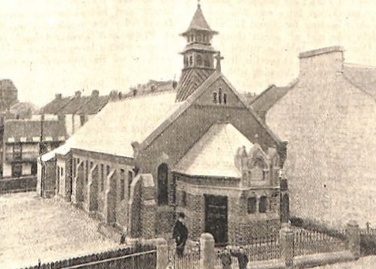
St Luke’s, Wexford Street
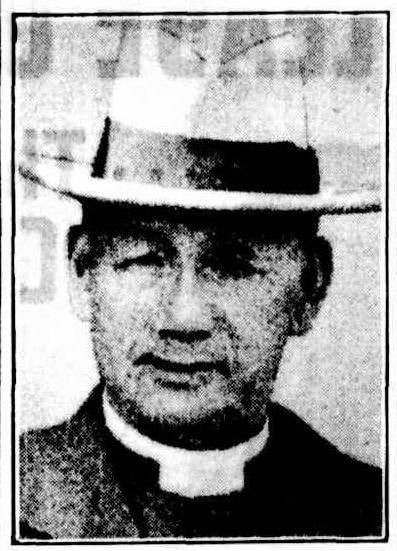
The Rev George Soo Hoo Ten